Newsletter / Research Activity Report / Satoshi Tanaka / Ryo Akama / Takanobu Nishiura
RARA Newsletter vol.18 How Interdisciplinary Integration, Visualization, and Sharing Are Transforming Academic Research, Art, Experience, and Society—Ritsumeikan University’s Vision for the Future of Digital Public Humanities
2025 / 09 / 05

2025 / 09 / 05
In this issue of Newsletter, we are delivering an in-depth report on the symposium held on July 12, 2025, at Ritsumeikan University’s Osaka Ibaraki Campus to commemorate the 155th anniversary of the founding of Ritsumeikan and the 125th anniversary of the founding of the Academy.
Report: A prominent symposium attended by about 300 online and offline participants
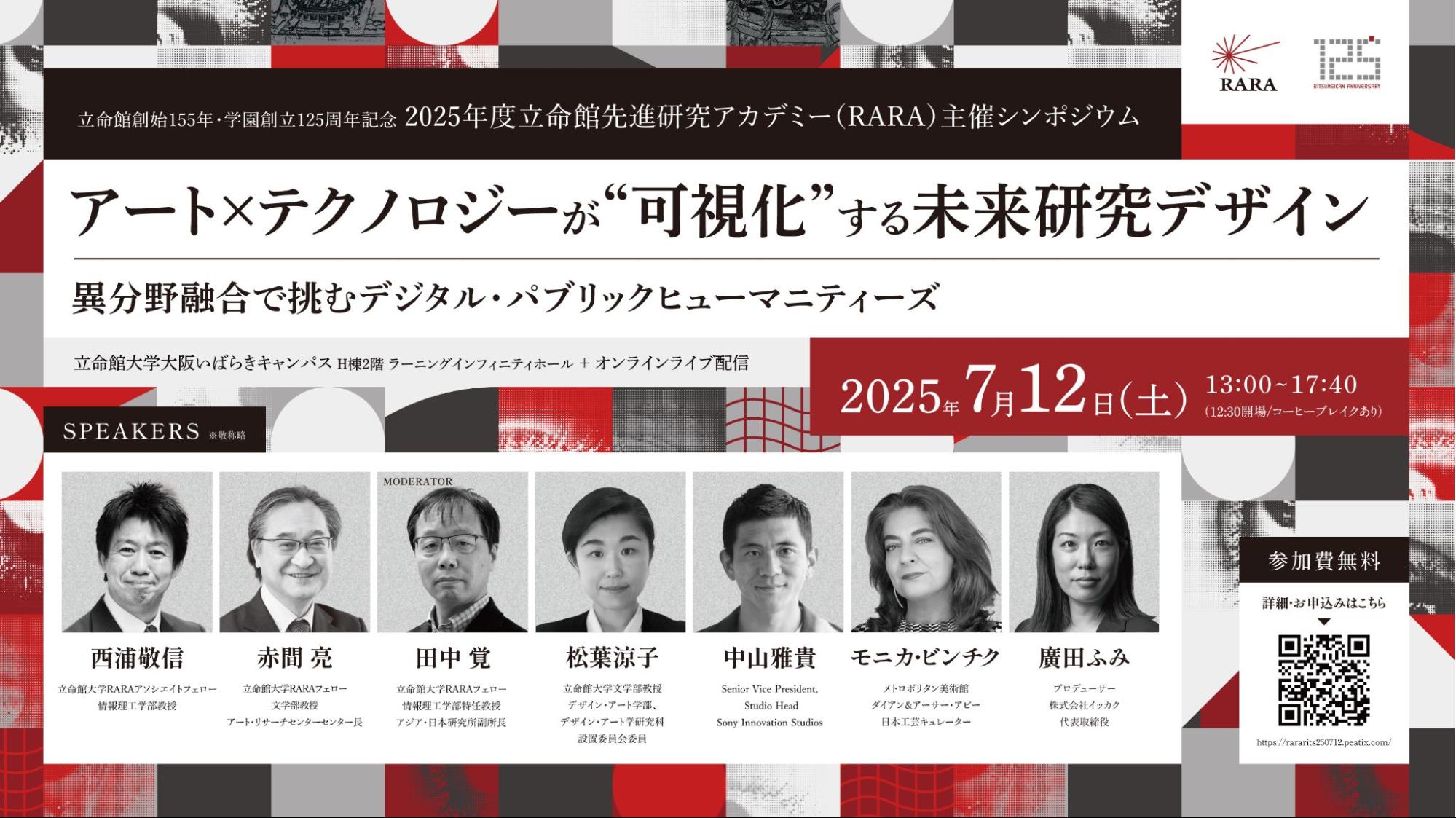
The symposium, entitled “Future Research Design ‘Visualized’ by Art and Technology – Approaching Digital Public Humanities with Interdisciplinary Research,” was held at Ritsumeikan University’s Osaka Ibaraki Campus and simultaneously streamed online via Zoom Webinar. The event opened with welcoming remarks by President Yoshio Nakatani, followed by an address from Professor Yasushi Kosugi, Director of the Asia-Japan Research Institute, a co-sponsoring institution. Against the backdrop of the rapid advancement of technology, participants engaged in lively discussions centered on fundamental questions such as “What does it mean to be human?”, “Where does creativity originate?” as well as what technology and academia should seek to “visualize” and “share.”
New meanings of “visualization” and “public”
Professor Satoshi Tanaka (RARA Fellow; College of Information Science and Engineering) commenced the proceedings by explaining the objectives of the symposium. “Through the organic integration of humanities and cutting-edge ICT, we would like to consider a new approach to academic research that is open to society. This means that advanced technology will revolutionize the very style of research itself.”

He then explained the keywords featured in the topic of the symposium. “‘Visualization’ doesn’t simply mean turning things into images; it refers to making content that anyone can grasp with their own minds. Meanwhile, ‘Digital Public Humanities’ means anyone can participate in research— not just university personnel, but also people from society and industry. This vision, which we have dubbed the Digital Public Humanities Paradigm, is still being developed, but I hope we can explore it further through today’s discussions.”
Six experts present on leading-edge “Art × Technology” initiatives
The relay-style talks by the speakers were organized into three sections: “From the Perspective of Technology,” “From the Perspective of Corporate and Social Activities,” and “From the Perspective of the Humanities.” A total of six speakers, two in each section, highlighted leading-edge “Art × Technology” initiatives from their respective standpoints. In addition to researchers from Ritsumeikan, the symposium laid the groundwork for multifaceted discussions by welcoming three external experts—one active at the forefront of Hollywood film production, a representative from one of the world’s largest art museums, and one working on the frontlines of media art.
From the Perspective of Technology: “Digitally preserving and recreating the soundscape of Gion Festival music”—Takanobu Nishiura, RARA Associate Fellow

“The Gion Festival has been a summer tradition in Kyoto since the 9th century, and the Gion Festival music played on the Yamahoko floats (the traditional festival floats of the Gion Festival) consists mainly of three instruments: handheld gongs, drums, and flutes. The songs differ by district, and there are thought to be around 1,000 songs across 35 districts.”
Professor Takanobu Nishiura (College of Information Science and Engineering), who specializes in acoustic informatics, presented his work on the front lines of digitally preserving intangible cultural assets, using Gion Festival music as a case study. He also gave a live demonstration in which participants experienced the performance of Gion Festival music, from reading the musical notation to learning the actual playing techniques.

One of Prof. Nishiura’s technical outcomes was to recreate Gion Festival music using a three-dimensional sound system based on Dolby Atmos.® “By recording a full 360-degree sound environment and reproducing it with each performer positioned in their appropriate spots, I was able to create an immersive soundscape that captures the acoustics of machiya townhouse interiors, including the reverberations from the walls.”
He also spoke passionately about his future research ambitions, saying, “I want to make possible, through the power of technology, what was previously impossible,” citing projects such as non-contact audio extraction from old records and the digital reconstruction of phonographs from the Meiji era.
“Using ICT to visualize internal structures that are not visible in reality” —Satoshi Tanaka, RARA Fellow

Professor Satoshi Tanaka (College of Information Science and Engineering) gave a presentation on the digital preservation of cultural properties using three-dimensional measurement technology.
“Three-dimensional measurement is a technology that precisely captures the colors and textures from three-dimensional shapes in the real world and brings them into the digital realm. The resulting point-cloud data represent a new type of big data, consisting of at least tens of millions of points, and in some cases exceeding several billion.”
Using the Gion Festival’s Yamahoko floats as an example, he noted that while their internal structures are hidden once fully assembled, ICT makes it possible to visualize those internal features that cannot be seen with the naked eye. He also spoke about efforts to digitally preserve the assembling process, which is itself an intangible cultural asset, by recording each stage of Yamahoko assembly in chronological order.

Furthermore, he presented a large-scale project conducted at the Borobudur Temple Compounds in Indonesia, illustrating how 3D measurement technology can be used at a UNESCO World Heritage site. “The external structure was captured through three-dimensional measurement, the internal structure was reconstructed using UNESCO boring survey data, and the wall reliefs depicting Buddhist narratives were restored from photographs using AI. All of these elements were then integrated and unified into a single point-cloud dataset,” he explained, detailing the comprehensive digital preservation method that combines multiple technologies. He also talked about the joint project between Sony Innovation Studios and Ritsumeikan University to conduct 3D measurements of the Ninomaru Palace and Honmaru Palace at the Nijo Castle World Heritage site as well as the many visualizations (i.e., realistic visualization, transparent visualization, and skeletonization) derived from these measurement data utilizing ICT.
From the Perspective of Corporate and Social Activities: “The frontiers of spatial digitization technology and its potential applications for visual contents” —Masaki Nakayama, Sony Innovation Studios

Masaki Nakayama, Senior Vice President and Studio Head of Sony Innovation Studios, discussed spatial digitization technology from the front lines of Hollywood film production.
“What we’re doing is using lasers to obtain precise location data, taking numerous photographs, and then mapping the color information from those photos onto the location data. We’re tackling the challenge of not only creating 3D digital models but also capturing visual contents using those models,” said Mr. Nakayama.
As a specific example, he then spoke about the digitization of Nijo Castle, an ongoing joint project with Ritsumeikan University. He presented high-definition images demonstrating the results of precisely capturing in three dimensions the Shokaku-no-ma (Pine and Crane Room) in the Honmaru Palace and the Ohiroma (Great Hall) in the Ninomaru Palace, where the restoration of imperial power to the emperor is said to have taken place.

“If we tried to actually film there, it would be a disaster if a drone crashed into the fusuma sliding doors, which are cultural heritage. Also, since the floor is also a cultural heritage, we aren’t allowed to lay rails. Even in places that are inherently difficult to film, digitization would open up possibilities for future visual production.”
Mr. Nakayama also explained virtual production technology using LED displays. “By projecting 3D models onto LED walls instead of using green screens, we can create images that appear more natural,” he said, discussing the future possibilities of visual production.
“Openness created by integrating art and technology”—Fumi Hirota, IKKAC Co., Ltd.

Next, Fumi Hirota, an international media art producer specializing in cultural policy and media art production, spoke about the importance of “openness” in the integration of art and technology.
“We operated a new facility called Civic Creative Base Tokyo together with the Tokyo Metropolitan Government. To distinguish this endeavor from conventional cultural facilities, we’ve launched various collaborative projects with citizens, such as developing an AI-based competition and creating AR app-based art appreciation experiences.”

As examples of integrating traditional performing arts with digital technology, she presented works featuring Tokushima’s Awa Odori dance and Okinawa’s Eisa, a traditional Okinawan bon-odori dance. “While we use motion capture and 3D scanning, our focus is less on archiving and more on elevating these traditions into new content.”
Ms. Hirota noted that when leveraging cultural resources through technology, “it is essential for the future that platforms, content, modes of expression, and methods of distribution and experience be designed as an integrated whole.” She also indicated the potential of a collaborative approach, stating, “The people participating in creation are diversifying, and the value is shifting towards creating by sharing information and tools. This can also be seen as a characteristic feature of creating with technology.”
From the Perspective of the Humanities: “How the Metropolitan Museum of Art made 500,000 artworks available online” — Monika Bincsik

In the next session, Dr. Monika Bincsik, Curator for Japanese Decorative Arts at the Metropolitan Museum of Art, gave a presentation on the digital strategy employed by one of the world’s largest art museums.
“Museums play a pivotal role in preserving and sharing humanity’s culture, history, and creativity. They are not merely places to store and display objects, but also spaces that create meaningful and engaging experiences for visitors.”
Dr. Bincsik then spoke about the Metropolitan Museum of Art’s initiatives in detail, such as the development of a system that make 500,000 collection items available online and allow users to freely download high-resolution images. “People can download photos of works to use in their own PowerPoint presentations or publish in books. Also, students can use them in their studies. It’s best when everyone can use them freely,” she stated, emphasizing the importance of open access.

Giving examples of how the museum uses digital technology, she talked about their virtual tours, audio guides, and interactive programs for children. “Digital technology should not replace traditional exhibitions; rather, it should be used carefully to enhance them,” she stated.
“From digital archives of cultural resources to Digital Public Humanities”— Ryo Akama, RARA Fellow

Director of the Ritsumeikan University Art Research Center, Professor Ryo Akama (College of Letters) reflected on more than a quarter-century of work in digital archiving and shared his vision for the Digital Public Humanities project.
“I began this work in 1989, and I am probably the first person in Japan to have deliberately pursued digital archiving. “In the wake of the Great Hanshin-Awaji Earthquake and later the Great East Japan Earthquake, the importance of digital archives has come to be widely recognized.”
Regarding the designation of the Ritsumeikan University Art Research Center as a Joint Usage/Research Center by the Ministry of Education, Culture, Sports, Science and Technology (MEXT), Prof. Akama remarked that “this holds significant meaning as we are the only private university to have received this designation.”

As a defining characteristic of the Digital Public Humanities project, Prof. Akama highlighted its “potential to shift scholarship away from exclusive domains controlled by a limited number of experts toward the creation of a research culture in which a wider range of participants can produce cultural information themselves.”
He also spoke about AI-driven research support systems as follows: “By clicking through materials in a game-like manner, students can learn to read classical literature. Within such environments, we are beginning to see the emergence of citizen researchers from the general public.”
Panel Discussion: Challenges and Prospects for the Future “Three Possibilities and Two Issues Raised by Digital Technology” — Professor Ryoko Matsuba (College of Letters)

To kick off the panel discussion in the second half of the symposium, Professor Ryoko Matsuba (College of Letters), who is involved in preparations for the establishment of the College of Arts and Design, summarized the presentations from Part I using three key perspectives.
(1) Reproducing experiences and techniques
“While it is difficult to fully reproduce the experience of viewing an artwork, the availability of high-resolution digital reproductions makes it possible to gain an understanding of the techniques underlying the creation of that artwork. Therefore, visualization enables reproduction in both of these senses.”
(2) The gap between expertise and non-expertise
“There is a gap between those who create works and those who view them. However, if technology allows us to extract certain defining features, might it not enable us to come closer to seeing works through the eyes of experts? Moreover, by compressing the time required to acquire specialized knowledge, technology can help bridge the expertise gap.”
(3) Opening to the public
“Digital technology should be used in a complementary manner that enhances works of art, so it is important to utilize digital data in manners that align with visitors’ expectations and follow the established flow of the viewing experience. When expert knowledge is shared via digital technology, new communities begin to take shape.”
Discussion: Sustainability and authentic value
Next, Prof. Matsuba raised two key issues.
Regarding sustainability and the value of digital reproductions, she noted: “The question is how art and history museums can contribute to a sustainable society.” She continued: “Since special exhibitions consume a great deal of money and energy, the use of high-definition digital reproductions will likely come to be contemplated from the standpoint of environmental impact. But then, we are confronted with the fundamental challenge of what is authentic value and how to develop the ability to discern authenticity.”
She added: “The discerning eye is something that cannot be easily verbalized. In an era where AI can create things that appear authentic, a critical challenge is how to convey to the next generation of talent the sense of how to perceive things through the physical senses. This is also a fundamental issue for human resource development,” she said, raising the issue of how to pass on discernment.
The true integration of Humanities and Sciences made possible by advancements in ICT
During the panel discussion, Prof. Tanaka made the following comment on the differences between Humanities and Sciences: “I have been involved in interdisciplinary research for more than 20 years since joining the Art Research Center project. Those in Sciences seek to develop new methods and technologies, while those in Humanities are more interested in presenting new insights and perspectives rather than new technologies. Understanding these differences, I have spent a lot of time grappling with how to bring them together and make them work as one.”
Prof. Tanaka then discussed how advancements in ICT are fundamentally changing the integration of Humanities and Sciences. “All technologies, including AI and voice processing technologies, have been making steady progress. Generative AI can handle automatic translation and overviews, and video processing can also be done with AI. Supported by these kinds of technological advances, the integration of Humanities and Sciences has undoubtedly been accelerating. ICT is steadily lowering the barriers between Humanities and Sciences, making it easier for researchers from different fields to engage in discussions. Moreover, research in Humanities is being transformed through advances in science and technology, while research in Sciences is, in turn, advancing to accommodate new kinds of data provided by fields in Humanities. This fusion of disparate elements brings about innovation.”
New value created by digital archives
Prof. Nishiura suggested that “the digital archiving of intangible cultural properties has the potential to generate new forms of value.” He continued:
“Because we can use computers to recreate the past, present, and even the future of Gion Festival music, I want to find new value in what users feel when they encounter differences in sound. With the power of technology, I want to make possible what was not possible before. Using technologies to extract sound from old records that could not previously be played or using computers to generate the tones of ancient instruments—these are precisely the kinds of bold efforts that will turn the ‘impossible’ into the ‘possible.’”
Then, Prof. Nishiura discussed the relationship between visualization and approaches to exhibitions as follows: “When it comes to sound, there are already more opportunities to listen to recorded music than to live performances. In other words, processed digital sound has become the dominant mode. Similarly, in the preservation of cultural properties, it is important not just to display items for their protection; how they are presented—that is, how they are seen and heard—is becoming increasingly important in engaging people. We need to think seriously about the potential for creating new value through the integration of Humanities and Sciences, using technology as a catalyst.”
In response to Prof. Nishiura’s remarks, Prof. Akama touched on the paradigm shift brought about by the digital preservation of intangible cultural properties: “Interpersonal relations and time were the most difficult aspects for the archive to capture. With advances in acoustic technologies making this increasingly feasible, we are now at a stage where the very concept of what an archive can be is undergoing a major transformation.”
The essence of Interdisciplinary integration: An engineer’s perspective
Prof. Tanaka explained the essence of interdisciplinary integration from the standpoint of an engineer. “It is true that the truth lies in the details. While conducting measurements in Indonesia, we discovered that the right ear of a certain Buddha statue was larger than the left one. This was because it had been designed so that moonlight would enter through the right ear, revealing the creator’s intent in a very subtle detail. We only came to know this thanks to high-precision measurement data.”
He went on to note the impact of science and technology on humanities research, stating, “When we acquire point-cloud data using our technologies, we can create a digital copy of the real world and visualize structures and relationships that were previously invisible. This is not merely an application of technology; it has the potential to transform the very nature of research itself.”

Value that cannot be gauged by cost-effectiveness alone: Potential for industry-academia collaboration
Mr. Nakayama raised a practical issue from his standpoint in the private sector. “The protection of cultural properties is generally considered as a field that does not generate profit for ordinary companies. Whenever we try to work on an archive or other such project within the company, we are always asked if it will make a profit or whether the cost can be recouped.”
Touching on the Nijo Castle project, Mr. Nakayama explained: “We want to make this project a win-win situation for everyone involved, regardless of their different motivations. The people at Nijo Castle are interested in digital archiving and want to preserve materials in the highest resolution possible. Ritsumeikan University wants to collect data for academic research, while we have the technical expertise but lack access to the filming locations. By aligning these vectors on this occasion, we were able to make the project a reality.”
“There are many initiatives that may not be profitable but are still worth pursuing. What is important is creating the mechanisms to make those initiatives viable. I believe that what one company cannot do on its own can often be realized when academia takes the lead,” he said, expressing his expectations for the role to be played by universities.
Social implementation of digital archives and the role of academia
Ms. Hirota pointed out that “the meaning of digital archives is changing, and there is now a growing demand to consider how they can be utilized beyond use by researchers,” emphasizing the importance of social implementation.
“When working on the project for the Tokyo Metropolitan Government, we researched major art museums overseas, and the difference in scale was immediately apparent. How to make effective use of financial and human resources is also an issue the government needs to address. In Japan, a recent trend is that discussions on digital archives are extending to how they can be used for regional revitalization as well as to increase the engaged non-resident population of a given region.”
Furthermore, Ms. Hirota addressed changes in creative practice brought about by technology: “Technology-driven production has itself become a foundation for co-creation. As methods of creation change, the nature of collaboration also changes. Having both technology and physical sensation is critical for creating experiential value. I believe universities can become places that cultivate and foster these kinds of interdisciplinary initiatives,” she said, expressing her expectations for the role to be played by academia.

The Met’s pioneering digital strategy and the transformed experience
Dr. Bincsik reflected on her experience at the Metropolitan Museum of Art. “When I first joined the museum as a curator, the director instructed us to make all database information publicly available. At the time, all of the curators were opposed to the idea. There were issues such as poor image quality and inaccurate data.”
She then explained that the Met’s digital open-access initiative, one of the first in the world, gave rise to new forms of communication with visitors. “By exchanging information across a variety of platforms, the way we communicate with visitors changed completely,” she said.
She continued by pointing out the complementary relationship between digital and physical experiences: “Young people are accustomed to seeing the world through screens. They share data with their friends, and that can lead to friends deciding to go someplace together.”
At the same time, she strongly emphasized the irreplaceable value of encountering original works: “Experiencing real works of art is extremely important. When people see a great artwork in person, they are moved —some visitors even stand in front of a piece and shed tears. That kind of response simply cannot be replicated when viewing the work on a small screen.”
Digital Public Humanities: Possibilities for collaboration with citizen researchers
Prof. Akama provided a detailed explanation of “Digital Public Humanities,” a concept that also appears for the title of the symposium.
“Digital Public Humanities aims to shift from exclusive scholarship by a limited number of experts toward the creation of a research culture in which a wider range of participants can produce cultural information themselves. This is an effort to fundamentally transform the conventional approach to humanities research.”

According to Prof. Akama, this shift is due to the rapid development of AI technology. “We have entered an era where, in a short time, AI can surpass the knowledge we researchers have spent years developing. Researchers are in a state of trepidation, wondering how to respond when AI eventually exceeds their own knowledge.”
On the other hand, he noted that digital technology is also opening up new possibilities. “Within the digital environment, citizen researchers are starting to emerge. Citizens are now writing scholarly critiques akin to academic papers, using digital data made available by the National Diet Library.” Prof. Akama emphasized that the crucial factor is the deep knowledge possessed by the owners of cultural properties and members of the local community. “People who own cultural properties possess tremendous knowledge. We want individuals with deep personal connections to and a profound knowledge of those properties to participate in our research. This is the true meaning of the word ‘public’.”
Prof. Akama stated that “Digital Public Humanities represents a new academic approach where not only universities, but also everyone including working individuals, industry representatives, and citizens can participate in research,” stressing the importance of knowledge creation through collaboration between experts and citizens.
Technical questions about acoustics and the light fluctuations
The audience raised a number of technical questions. In response to a question about the acoustics of the Noh stage, Prof. Nishiura explained how his team analyzes the acoustics of traditional architecture. “A Noh stage is fundamentally different from a conventional concert hall. Performances are presented using only the natural voice, without microphones or speakers. In addition to the fact that the distance from the stage to the audience is meticulously calculated and reflected in the design, Noh stages also incorporate special acoustic features. Ceramic pots are installed beneath the floor so that stepping on them produces resonance, thereby amplifying the sound. With current technology, even these complex acoustic characteristics can now be visualized using physical models. This is truly the result of the integration of Humanities and Sciences in an effort to scientifically elucidate traditional techniques.”
In response to a question about fluctuating light, Prof. Tanaka explained the technological possibilities as follows: “With dynamic phenomena that change over time, colors can appear to shimmer—sometimes subtly and sometimes dramatically. Take, for example, the flickering of candlelight, which is a complex phenomenon. Accurately simulating and rendering such effects require enormous computational power. With the capabilities of today’s computers, real-time processing is difficult, but technically it can be done if you take enough time. Over the past decade, however, computer graphics technologies for visualizing intangible phenomena have advanced dramatically. For example, using new simulations driven by generative AI, the real-time visualization of fluctuation may soon become commonplace.”
On the value of the real and the non-real
A member of the audience asked the panelists for their thoughts on the respective value of faithfully reproducing what exists in reality versus creating something that surpasses reality, and each speaker shared their views on the essence of creativity and digitization.

“Even forms of expression that are not strictly ‘real’ can be beautiful and deeply moving. Analytical visualizations that reveal the internal structures of cultural properties invisible in the real world or that clearly emphasize three-dimensional structures may not be photorealistic, but they bring about new kinds of aesthetics and discoveries. These are precisely the things that can be achieved with computer graphics.” (Prof. Tanaka)
“When it comes to sound, there are already more opportunities to listen to recorded music than to live performances. In other words, processed sound that is not ‘authentic’ has become mainstream. Similarly, I believe we can discover new value that is distinct from conventional approaches in sound experiences created using digital technology.” (Prof. Nishiura)
There are definitely points of view that are not possible without digitization, such as seeing things from an insect’s perspective rather than a human’s, which allows us to see things differently. For example, traditional Japanese houses are generally designed to be seen from a human-eye level, but looking at them from an entirely different vantage point may lead to discoveries. The ability to provide these kinds of ‘non-existent’ perspectives is one of the strengths of digital technology.” (Mr. Nakayama)
“Art is a field that continually assigns new value as an element of culture. While museums seek to preserve works faithfully as cultural assets, in the world of art, the real challenge lies in how to add new value to existing data and how to create new cultural meaning. Creative practice driven by technology has itself become a method for generating new forms of value.” (Ms. Hirota)
In the world of art, it is entirely natural for older works to inspire new ones. Artists drawing inspiration from past works to create something new is a fundamental part of the creative process. Having said that, it is important not to rely on technology alone to produce works mechanically, but to respect the ideas and creativity of the human artist. Technology should serve as a tool that supports creativity and nothing more.” (Dr. Bincsik)
“With digitization, it is impossible to create something complete. At best, we can only extract parts of reality. If we do not understand the ‘embodied nature’ of a work, we cannot understand what should be extracted into digital form, and digitization itself becomes impossible. It is by recombining what has been extracted in new ways to create something new that truly new value is created. This way of thinking lies at the heart of the philosophy of the College of Arts and Design, which is scheduled to open next year.” (Prof. Akama)
“New insights into interdisciplinary integration”: High praise from diverse standpoints
The post-event survey revealed high levels of satisfaction, along with a wide range of thoughtful comments from the participants.
One student commented: “I learned new ways to approach interdisciplinary integration. Having spent a lot of time thinking about what the integration of Humanities and Sciences entails and what it can generate, I was able to gain invaluable insights from this symposium.”
Meanwhile, one working professional noted that “it was interesting to learn about initiatives and trends in the integration of Humanities and Sciences and collaboration among industry, academia, and government under the topic of art x technology.” Researchers offered reflective evaluations, such as the following: “Interdisciplinary integration is easy to talk about but requires real courage and resolve in practice. I believe there is great significance in organizing an event like this. Since a new College will be opened, I hope it will function as a cutting-edge site for interdisciplinarity and emergent potential.”
In addition, many participants expressed expectations for the future, with comments such as:
“I look forward to new initiatives originating in Kyoto that bring together art and technology, as well as research activities that carry precious cultural heritage forward to future generations,” and “The concept of ‘public humanities’ struck me as holding exciting new possibilities.”

Supporting the next generation of researchers and fostering exchange: Poster session by RARA Student Fellows
A poster session by RARA Student Fellows was held during the coffee break.
RARA supports research activities by designating outstanding doctoral students as RARA Student Fellows, recognizing them as the next generation of researchers.
On the day of the event, many participants visited the poster session and interacted with the students. In a casual and interactive atmosphere distinct from the main symposium sessions, lively conversations unfolded around the students’ research topics and their visions for the future.

Participants commented that “the students’ passion for their research really came through” and that it was “an invaluable opportunity to see the future potential of young researchers.” RARA will continue to place strong emphasis on nurturing the next generation of researchers and on building a vibrant research community.
RELATED NEWS
-
Satoshi Tanaka
Professor Satoshi Tanaka appointed Director of the Art Research Center at Ritsumeikan University
2026 / 04 / 01
VIEW DETAIL
-

Kota Suechika
Professor Kota Suechika’s research findings on “Area Studies 2.0” published in Third World Quarterly
2026 / 03 / 18
VIEW DETAIL
-
Ryo Akama Satoshi Tanaka
Professors Ryo Akama and Satoshi Tanaka participated in and presented at the Sustainability Forum held at the University of Bologna
2026 / 03 / 18
VIEW DETAIL