Newsletter / Research Activity Report / Satoshi Konishi / Eiji Yamasue / Hisaaki Mihara / Takashi Minemoto / Shima Okada / Satoshi Soda
RARA Newsletter vol. 11 Report on “RARA Commons.” Comprehensive Discussion of Various Collaborations and Researcher Careers
2024 / 12 / 25

2024 / 12 / 25
RARA Commons Held as “Nodes” Connecting Educational and Research Activities
This issue of the Newsletter reports on the RARA Commons held at Biwako-Kusatsu Campus on November 20, 2024.
RARA Commons is an initiative for RARA Fellows and RARA Associate Fellows to share and promote their research as “nodes” connecting educational and research activities.
The theme of this event was “Collaboration and Career Paths for Researchers in Science and Engineering Aiming to Create New Value.” 110 attendees including undergraduate and graduate students attended the event, which was replete with advice regarding the importance of cross-disciplinary collaboration and career development.

The event began with a welcome speech by Professor Takeyuki Okubo, Dean of the Division of Research, and a keynote address by Vice President Yoshifumi Noguchi.


Session 1: Collaboration to Form Ritsumeikan Knowledge Nodes (RKN)
In the first session, RARA Fellows Satoshi Konishi, Professor at the College of Science and Engineering, Hisaaki Mihara, Professor at the College of Life Sciences, and Eiji Yamasue, Professor at the College of Science and Engineering, spoke on the theme of “Collaboration to Form Ritsumeikan Knowledge Nodes (RKNs).” They spoke of their own experiences in their respective research fields and approaches to interdisciplinary collaboration.

“Let us be honest with our genuine passions”—Professor Satoshi Konishi

On the theme of his research, Prof. Konishi said, “My research focuses on the connections between us in the physical space and the digital space. Specifically, it involves linking the worlds through sensors and micromachines.”
In 2022, his research team successfully measured the leg and torso strength of a pill bug using a microfinger of a few millimeters in size equipped with a tactile sensor, garnering considerable attention. This technology is a concrete demonstration of the new concept of a “tactile microscope,” which Prof. Konishi has been advocating for some time, and is expected to find application in medical and other fields.
On selecting research themes, Prof. Konishi said, “Do what you want to do. If you do that, something will come of it.”
“I started my research at Ritsumeikan University just as the BKC campus was constructed on the shores of Lake Biwa. At the time, I had just obtained a doctorate degree and followed my heart to pursue the research I really wanted to do. In the ensuing 28 years, I have been researching microrobots and saiborgs (cyborgs made using cells which are pronounced “saibou” in Japanese). The microfinger technology that came out of this is currently being used to develop palpation robots in collaboration with Kyoto University Hospital, and applications in the medical and pharmaceutical fields are also being explored.”
Furthermore, on the saiborg side, we are building an artificial biological system that combines cultured cells with sensors and micromachines to connect the digital space with the physical space. “This may enable us to control and network cell movements and stimulations,” Prof. Konishi added.
He spoke on the key aspects of interdisciplinary collaboration based on his experiences. “Interdisciplinary collaboration makes your life immensely fulfilling. To collaborate with people from different fields, you must respect others while also focusing on your expertise. Collaboration is possible only if you share the vision of creating new value with others.”
“The world of microorganisms presents unexplored fields. Achieving a sustainable future through multidisciplinary collaboration”—Professor Hisaaki Mihara

Prof. Mihara spoke on the theme of “Microorganisms Open Up New Worlds” and explained the motivation for his research.
“I first encountered microorganisms that live in high-temperature environments of 60–70 °C when I was a university student in a research lab. I was fascinated by the amazing vitality and began to explore microorganisms. However, microbiology was not my first choice in the beginning. I was more interested in plant genetics, but there were many aspirants in that field, so I lost at rock-paper-scissors and ended up pursuing microbiology. That choice made me who I am today.”
Prof. Mihara described the diversity and function of microorganisms and their impact.
“Microorganisms are the most diverse organisms on this planet, and all organisms coexist with them. For example, our bodies have about 2.5 kg of microorganisms at all times. Did you know these microorganisms have a significant impact on the global environment? They are deeply involved in the production of greenhouse gases like carbon dioxide and methane as well as climate-cooling gases.”
On the other hand, there are still many fields related to microorganisms that have not yet been elucidated. “Only 0.02% of all microorganisms are currently said to be known. The remaining 99.98% are still unknown. I believe understanding the unknown is important in exploring the sustainability of humanity.”
He cited concrete examples of how microbiological research could help in the preservation of the global environment and in addressing climate change. “For example, spraying iron in the ocean stimulates microbial activity and promotes the growth of diatoms. This leads to the fixation of carbon dioxide as calcium carbonate, which can be deposited on the seafloor. In this way, we can find new solutions to environmental problems using microorganisms.”
He also emphasized the importance of cross-disciplinary efforts in microbiological research. “On our own, we microbiologists have limitations. I believe we can build a sustainable future by collaborating with researchers in other fields, such as agriculture, climatology, and international law, and combining our knowledge,” Prof. Mihara concluded.
“New insights into complex issues through ultra-interdisciplinary research”—Professor Eiji Yamasue

Prof. Yamasue, who specializes in industrial ecology, spoke of his research career and explained how he came to adopt an interdisciplinary approach.
“I had been working on environmental materials and steelmaking technology when I began to wonder, ‘What are truly environmentally friendly materials?’ It may be illogical to produce a material that is 10 times stronger if it takes 100 times as much energy to make it. I thought that we should consider the entire lifecycle up to the point of disposal while conducting an environmental impact assessment. Since then, I have expanded my thinking beyond just material development to consider the entire life cycle of a material.”
He proceeded to discuss his growing interest in environmental education and behavioral science. “I realized that even if we develop unsurpassed technology and materials, it is meaningless if there is no accompanying awareness and literacy among users.”
He spoke in detail about the Resource Paradox Problem: “While the goals of decarbonization and dematerialization are important, there are contradictions in achieving them that lead to the excessive consumption of resources. For example, next-generation cars contribute to the reduction of carbon dioxide emissions, but producing such a car requires enormous resources. Can we use however much resources we need to achieve decarbonization?”
He emphasized the need for a multifaceted perspective to solve these complex problems. “We cannot solve complex problems with a single perspective. We need a comprehensive approach that includes not just science and technology, but also socioeconomic systems and changes to people’s behavior.”
Prof. Yamasue then discussed the role of interdisciplinary research, noting that, “Not merely crossing multiple fields, it is important for multiple fields to work closely to generate new insights. This is what we call ‘ultra-interdisciplinary research’.”
As a message to early-career researchers, he said, “Research always has constraints, but your results will vary greatly depending on how you perceive them. I consider constraints as the impetus for leaps forward. They can open up new possibilities.”
To conclude the session, the three professors answered questions from the audience and discussed the challenges, and key aspects of collaboration.
“Collaboration is a fantastic way to achieve things you cannot do on your own. However, successful collaboration requires a respectful attitude toward others, and a willingness to produce something valuable to each other.” (Prof. Konishi)
“Collaboration is not an end in itself; it is a means to an end. I believe it is crucial to create an environment where everyone can work together comfortably.” (Prof. Mihara)
“The benefit of collaboration is being able to satisfy your intellectual curiosity and share discoveries. To succeed, you need to be able to cooperate with others on an equal footing.” (Prof. Yamasue)
Session 2: RARA and Career Paths
In the second session, which was on the theme of “RARA and Career Paths,” RARA Fellows Takashi Minemoto and Shima Okada and RARA Associate Fellow Satoshi Soda, all of whom are professors at the College of Science and Engineering, discussed their career development and research efforts based on their own experiences and perspectives.

“Collaborating with peers and sharing goals”—Professor Takashi Minemoto

The first speaker in the second session was Prof. Minemoto, who introduced himself and then discussed his research and the turning points in his career.
“I am currently working on a new technology called perovskite solar cells. Unlike conventional solar cells, this technology is lightweight and flexible, so it has the potential to be installed, for example, on the walls of a building, factory roofs, or even the surface of cars or pools. I hope to use this technology to open up new markets for photovoltaics.”
Prof. Minemoto’s research has also been adopted by the Green Innovation Fund, a project under the New Energy and Industrial Technology Development Organization (NEDO). In collaboration with Sekisui Chemical Co., Ltd., he is using printing technology to develop solar cells that can be bent and expanding the applications of thin-film solar cells.
On his motivation for working on perovskite solar cells, he said, “Crystalline silicon cells, which have been a mainstream in solar power generation to date, have excellent performance, but they are bulky and limited in terms of where they can be installed. In searching for technologies that are light and easy to handle to solve this issue, we focused on perovskite.” He added that they are still evaluating and improving the product to increase durability in harsh outdoor environments and to maintain its long-term performance.
“Collaboration with other industries is essential for my research,” Prof. Minemoto noted. “For example, we are working with architectural firms and automobile manufacturers as we explore new possibilities to learn about the challenges of designing and deploying solar cells from their perspectives. As a researcher, it is important not to be limited to your own field and to have a broader perspective.”
Prof. Minemoto also shared some of the lessons and tips he learned over the course of his career development.
“I think one of the most important lessons is, ‘Do not neglect the fundamentals.’ When I was a student, my supervisor repeatedly taught me the importance of ‘having a solid foundation.’ I think that this is always a useful lesson when facing any challenge. Another important thing is ‘Perceive your own capacity.’ My supervisor once told me, ‘You cannot handle as much on your own as you might think.” I think that recognizing this helps us persevere in learning and achieve results.”
In his current research, Prof. Minemoto promotes collaboration with different industries and fields. “New ideas and solutions emerge by bringing in knowledge and perspectives from different areas of expertise. ‘Collaborating with peers and sharing goals’ are the most important elements in producing results. Find peers, grow together, and achieve results. You cannot conduct research entirely on your own. We can create new value only with the help of different people.”
“Believe in what you are passionate about, and push forward”—Professor Shima Okada

The next speaker, Prof. Okada, reflected on her varied career path and talked about her enthusiasm for research.
Prof. Okada, who has a master’s degree from Ritsumeikan University, said, “When I thought about continuing to a doctoral program, my family opposed the idea and I went to work at a company. But I still couldn’t give up on my research, so I majored in Health Science and earned a degree from Osaka University, whereafter I returned to the Department of Robotics in the College of Science and Engineering.”
Prof. Okada also touched on her own childhood experiences as the starting point of her research.
“My research addresses the question ‘How can humans and robots cooperate in terms of their minds?’ Since I was a child, I have had terrible eyesight and I had to wear thick glasses. Even now, I can barely see without contact lenses. I had to use my imagination to supplement the world I could not see. The only friend I had in this state was a toy robot, but it was never a real friend. This became the starting point of my research. It led me to the research theme, ‘How can we make robots that move people’s hearts and cure loneliness?’”
She is researching technology to quantify and model relationships and detect the state of loneliness. “I want robots to help break down loneliness by working directly with people as well as influencing their surroundings.”
Looking back on her career, Prof. Okada discussed facing various barriers and difficulties. “In particular, as I continued to my PhD, I had to face barriers such as family, financial problems, and social pressures. I reexamined my inner doubts and the challenges I wanted to solve before choosing a path forward.”
Prof. Okada also talked about her stance as a supervisor and researcher. “One of my supervisors once said, ‘Education is like lighting a fire and making it burn.’ This is the starting point of my teaching and research activities—I want to be someone who can ignite my students’ inner potential. I also believe it is my mission to break down the barriers to diversity and gender and create an environment where the younger generations can carry out research freely. I want to break down the barriers, if even only bit by bit, so that the next generation has a better environment in which to conduct research.”
She had the following message for the students:
“Be honest with yourself about your own questions and the challenges you want to solve. No matter how difficult the situation, I want you to find the thing you are passionate about in your heart and go forward believing in it. In the future, researchers will be required to go beyond their fields of specialization and cross various barriers. In this respect, I hope you do not sell yourself and your abilities short, but proudly demonstrate your value.”
“Taking a detour always leads to something. Develop an international perspective”—Professor Satoshi Soda

Finally, Prof. Soda spoke about the significance of research while reflecting on his career under the theme, “Water Environment Conservation Technologies in Asia.”
Prof. Soda is working on environmental issues related to water in Asia. Introducing his research in different regions, he said, “We are developing technologies to meet the challenges in different regions, such as treating wastewater from pig farming in Vietnam, removing trace chemicals in wastewater from pharmaceutical factories in India, treating wastewater from the wax-resist dyeing industry in Indonesia, and removing nitrogen from urban sewage in China.”
Prof. Soda spoke candidly about a turning point in his career.
“I was not proficient in English, and this was a big hurdle when I went to university and began my research activities. I grew up in the Miura and Yokosuka area, Kanagawa Prefecture, where I was in touch with nature, and I was interested in the aquatic environment. However, I did not pass the entrance examinations and had to take a year to prepare again. After that, I continued my studies and enrolled in Osaka University, where I began to study environmental engineering. When I first entered graduate school, I was not very good at communicating in English, and faced numerous difficulties. My supervisor in my doctoral program suggested short-term study abroad programs at research institutes in Switzerland and Germany. Although I faced many setbacks in environments where a good command of English is critical, these opportunities greatly contributed to my growth.”
He then went on to conduct postdoctoral work in Japan and began his career as an assistant at a newly established Graduate School of Osaka University. “My research did not progress according to my expectations, so it was a challenging time. Despite that, I was gradually able to build up my achievements with support from my supervisor and colleagues,” he recalled.
Based on his own experience, Prof. Soda said that he feels strongly about the importance of human resource development. He encouraged students by saying, “Not only do I want students to be able to carry out research, they also need to develop an international perspective and be able to respond to various challenges.”
“Even if life takes you on a detour, those experiences always lead to something. You must be prepared to seize new opportunities as they arise. I hope that the networks we have built and the knowledge we have gained through our research will be passed on to the next generation.”
During the question-and-answer session, the three professors answered students’ questions and stressed the importance of continuing to learn and challenge oneself as part of developing one’s career as a researcher.
“You must develop enthusiasm for learning on your own rather than being taught.” (Prof. Minemoto)
“You must not sell yourself and your abilities short, but work diligently with self-confidence.” (Prof. Okada)
“Always be prepared to jump at new opportunities.” (Prof. Soda)
Afterwards, RARA Student Fellows and the alumni gathered to share their motivations for proceeding to the doctoral program, their research topics, their experiences after entering the program, the fascination and significance of joining the doctoral program, and the utility of RARA’s multifaceted support, including financial, networking, and research assistance.

RELATED NEWS
-
Hiromitsu Maeda
Professor Maeda receives RSC Long-standing Editorial Service Award
2026 / 05 / 25
VIEW DETAIL
-
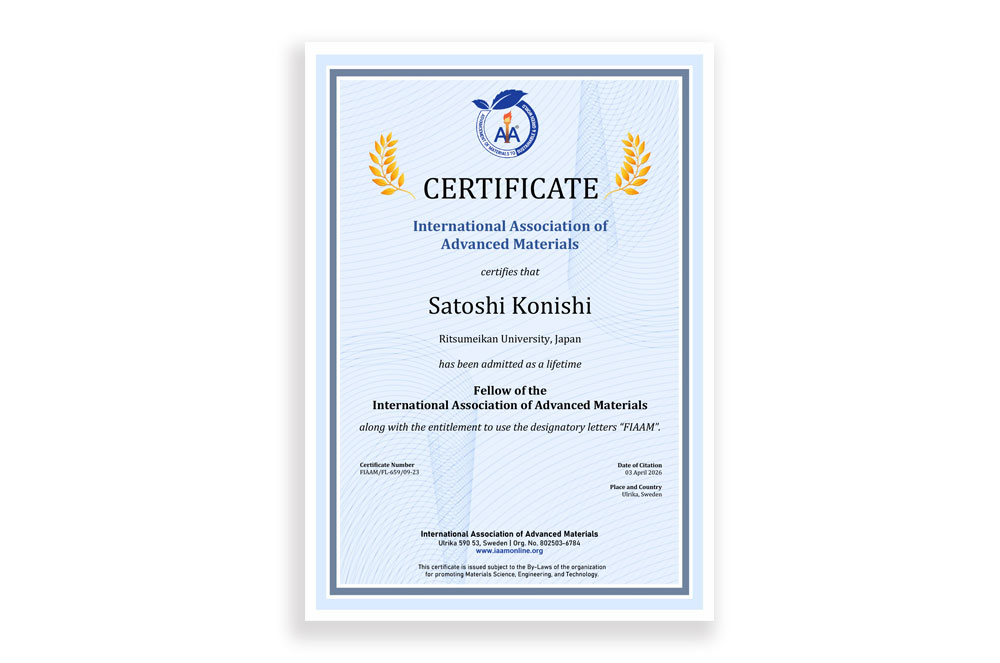
Satoshi Konishi
Professor Satoshi Konishi awarded the title of Lifetime Fellow of the International Association of Advanced Materials (IAAM)
2026 / 04 / 30
VIEW DETAIL
-
Satoshi Tanaka
Professor Satoshi Tanaka appointed Director of the Art Research Center at Ritsumeikan University
2026 / 04 / 01
VIEW DETAIL